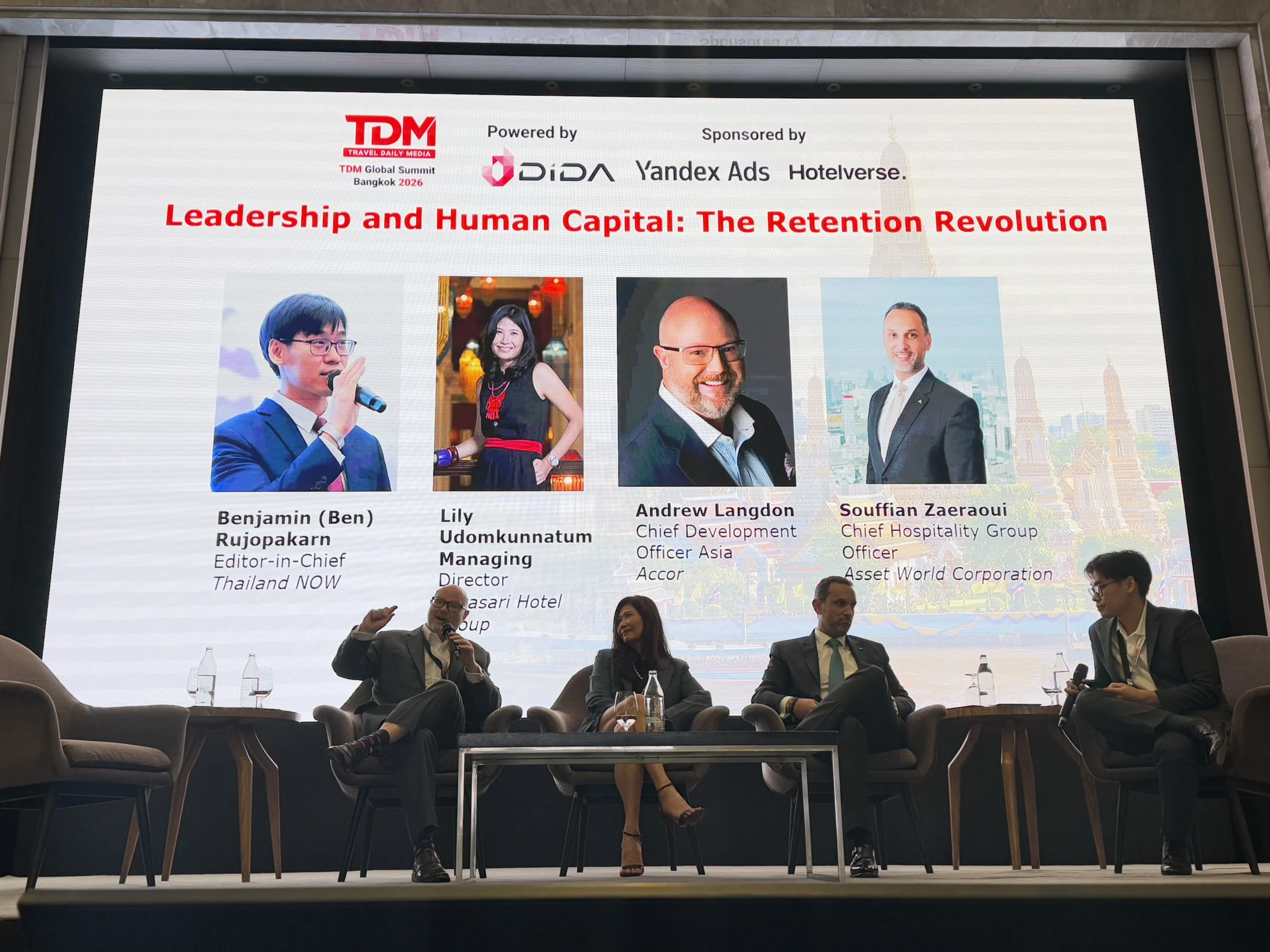

As international journey strikes towards a brand new period of development, hospitality leaders are more and more recognising that the business’s best problem is now not infrastructure, know-how or funding, however individuals. That was the central theme of the panel dialogue Management and Human Capital: The Retention Revolution on the TDM International Summit Bangkok 2026, the place business leaders examined how expertise shortages, altering workforce expectations and evolving management fashions are reshaping the way forward for hospitality. Moderated by Benjamin Rujopakarn, Editor-in-Chief of Thailand NOW, the dialogue introduced collectively Lily Udomkunnatum, Managing Director, Burasari Resort Group; Andrew Langdon, Chief Improvement Officer Asia, Accor; Souffian Zaeraoui, Chief Hospitality Group Officer, Asset World Company to discover how the business should rethink retention, management and profession growth whether it is to maintain long-term development.
A Expertise Disaster Years within the Making
The dialogue started with a transparent acknowledgement that hospitality’s labour problem is now not a brief disruption however a structural difficulty with long-term penalties. Panellists agreed that whereas the pandemic accelerated the disaster, the underlying pressures had been constructing for years, from shrinking expertise pipelines to rising competitors for expert workers. What has modified is the size of urgency.
Inns, audio system famous, are being compelled to rethink staffing fashions completely, working leaner than ever earlier than whereas asking groups to be extra agile and multifunctional. Effectivity has develop into vital, however so has confronting a deeper difficulty: there are merely fewer individuals coming into the business than the tempo of development requires. The priority is now not confined to filling frontline positions; it extends all the way in which up the organisational ladder. At the moment’s scarcity of operational employees, panellists warned, may shortly develop into tomorrow’s scarcity of leaders.
Hospitality Is Competing Past Hospitality
A key takeaway from the session was that hospitality is now not competing solely towards itself for expertise. It’s now competing with completely new sectors that supply completely different profession propositions, from know-how companies and digital platforms to creator economies and versatile work fashions.
Panellists noticed that youthful professionals more and more have options that promise autonomy, distant work and life-style flexibility — areas the place hospitality has historically struggled. Consequently, the business is now not merely attempting to draw individuals away from rival motels; it’s attempting to stay related towards industries that didn’t exist for earlier generations.
This shift has compelled hospitality leaders to confront a much bigger query: how can the business nonetheless place itself as an aspirational profession? For the panel, the reply lies not simply in higher recruitment, however in reimagining hospitality careers in a manner that aligns with the values of rising expertise.
The New Workforce Needs One thing Totally different
Generational change emerged as a significant drive reshaping retention. Audio system highlighted how youthful workers are bringing completely different expectations round work, life-style and profession development, usually prioritising goal, flexibility and private fulfilment alongside compensation.
Relatively than viewing these shifts as obstacles, panellists argued they characterize a immediate for the business to evolve. Conventional fashions constructed round inflexible shifts, hierarchical constructions and glued profession timelines might now not resonate with newer generations. Hospitality, they urged, should adapt by redesigning roles, rethinking schedules and creating extra flexibility inside operational realities.
More and more, persons are selecting employers based mostly not solely on wage or model status, however on whether or not they can see a sustainable life inside that profession. For hospitality to stay aggressive, it should show that the business can supply each alternative and a life-style individuals wish to construct round.
Management, Extra Than Pay, Drives Retention
One of many strongest themes to emerge was that retention is commonly pushed much less by compensation than by management. A number of panellists emphasised that workers don’t usually depart jobs alone — they depart poor administration, weak cultures and environments the place they don’t really feel valued or supported.
In that sense, management growth has develop into inseparable from expertise retention. But the stress created by labour shortages has additionally led many organisations to advertise individuals sooner than earlier than, generally earlier than they’re absolutely ready to steer. Whereas accelerated development can create alternatives, the panel cautioned that with out correct growth it might additionally create fragile management constructions that undermine engagement.
The answer, they argued, just isn’t merely sooner promotion, however stronger management pipelines. Investing in higher managers, higher mentoring and extra considerate management growth could also be one of the crucial efficient retention methods the business has.
Profession Paths Should Be Seen
The dialog repeatedly returned to the significance of constructing hospitality really feel like a real long-term occupation quite than only a sequence of operational jobs. Panellists harassed that profession development stays one of many business’s best strengths, however too usually these pathways usually are not seen sufficient to these coming into the enterprise.
Relatively than counting on summary guarantees of development, the panel highlighted the necessity to make profession growth tangible. Actual-life examples shared through the session — from safety employees rising into guest-facing management roles to entry-level workers turning into division heads — bolstered the distinctive upward mobility hospitality can nonetheless supply.
That story, audio system argued, must be communicated much more clearly, significantly to youthful generations who might not recognise the breadth of alternative the sector offers. As a result of in lots of instances, the problem just isn’t that hospitality lacks profession paths, however that these paths usually are not being showcased successfully.
The Way forward for Management Is Extra Native — and Extra Numerous
One other main dialogue level was how hospitality management itself is evolving. Panellists pointed to a major shift towards localisation, with extra management roles transferring into home expertise pipelines quite than counting on conventional expatriate constructions.
This evolution was framed not merely as a price or market actuality, however as a optimistic transformation that displays the rising maturity and functionality of native expertise. On the similar time, the dialogue touched on range in management, significantly round growing feminine illustration in senior roles.
Whereas girls make up a big share of the hospitality workforce, panellists acknowledged that this has not all the time translated into management positions. That, they argued, is altering — and may proceed to. Better range in management is not only about inclusion, however about strengthening retention by serving to workers see themselves represented in the way forward for the enterprise.
AI May Strengthen Hospitality, doesn’t Change It
Whereas synthetic intelligence featured closely throughout the broader summit, this dialogue approached it by way of a distinctly human lens. Relatively than viewing AI as a risk to hospitality jobs, the panel largely positioned it as a device that may strengthen each worker expertise and visitor service.
Audio system described AI’s function in lowering repetitive duties, accelerating coaching and permitting groups to focus extra on the high-value, human-centred elements of hospitality. Used thoughtfully, they argued, AI might help shorten studying curves, enhance effectivity and help expertise growth quite than displace it.
Importantly, panellists urged hospitality could also be among the many sectors least threatened by automation exactly as a result of real human connection stays at its core. In that sense, AI was framed much less as a disruption and extra as a method of enhancing the very service tradition the business is constructed on.
Why the Retention Revolution Issues
If the session delivered one overarching message, it was that retention can now not be handled as merely an HR operate. It’s a management precedence, a enterprise crucial and finally a development technique.
As journey demand expands, the business’s greatest constraint will not be market alternative however whether or not it has the individuals and management to maintain that development. Fixing that problem, the panel made clear, would require greater than hiring more durable. It should require rethinking how hospitality attracts expertise, develops leaders and positions itself for the following era.
As a result of in an business constructed on individuals, human capital might finally be its best aggressive benefit. And because the panellists made clear, the retention revolution is not only about maintaining expertise — it’s about securing the way forward for hospitality itself.