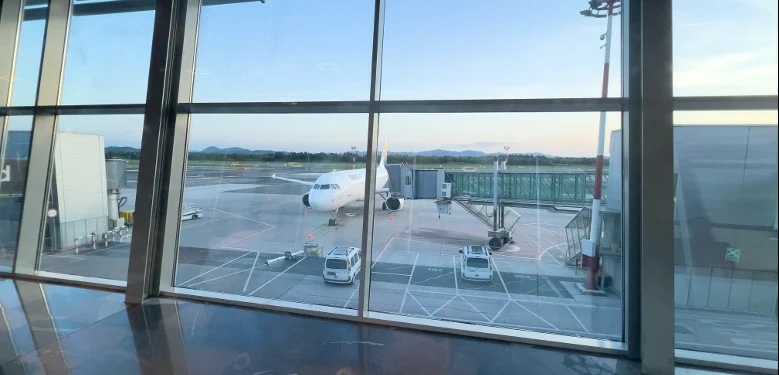

Whereas China’s 10-million-passenger airports compete on intercontinental nonstops and world connectivity, Taiyuan Wusu Airport has launched a moderately uncommon route:
Beginning March 29, a Taiyuan–Chongqing–Chiang Mai service has been launched, marketed as Shanxi’s first direct hyperlink to northern Thailand.
However it’s clear to anybody conversant in the trade that that is nonetheless a stopover service. Passengers should transit by way of Chongqing, which means it can’t be thought-about a real nonstop worldwide flight.
This isn’t an remoted case, however moderately a long-standing actuality for Taiyuan Airport.
As a normal 10-million-plus passenger hub—with 14.57 million passengers dealt with in 2025—Taiyuan Wusu Airport stands out as a uncommon case amongst its friends, with just about no real nonstop worldwide routes.
Just lately, the airport additionally launched through-ticket providers from Taiyuan by way of Chengdu Tianfu Worldwide Airport to Cairo, Melbourne, Rome, and Madrid, providing passengers a extra seamless expertise with by means of check-in and baggage switch.
Even so, these routes nonetheless depend on home hub connections moderately than originating as nonstop worldwide flights from Taiyuan itself.
The explanations behind this are already evident within the knowledge.
In keeping with CAAC statistics on route-based passenger throughput at China’s hub airports in 2025, worldwide passengers account for lower than 1% at Taiyuan Airport. Passenger demand is extremely targeting main hubs corresponding to Beijing, Shanghai, Guangzhou, and Shenzhen, with comparatively weak help from enterprise vacationers and unbiased outbound passengers—leading to a structurally low share of worldwide visitors.
Coupled with intense competitors from close by main worldwide hubs like Beijing and Tianjin, airways working nonstop worldwide routes from Taiyuan have lengthy confronted the strain of “dropping cash on each flight.”
Because of this, Taiyuan Airport has shifted towards a “connectivity by way of hubs” strategy, leveraging main home hubs to increase its worldwide attain. Whereas not probably the most direct path to world connectivity, it’s a extra commercially viable technique aligned with its native demand base and airline economics.